Observing Thinking

Observing Thinking
Observing Thinking

Thursday, June 8, 2023

 On AI Regulation


To pass laws that regulate how innovative technology will affect society requires a thorough examination of its expected  pros and cons and that includes predicting future effects on society. There is a  Buddhist aphorism that says, “the best way to clear up muddy water is to leave it alone” and while this insight works on many sorts of problems, it is a very dangerous approach to use on how to regulate AI.


Niels Bohr, the Nobel laureate in Physics and father of the atomic model, is quoted as saying, “Prediction is very difficult, especially if it's about the future!”.

I was not surprised when I saw the news last week that various titans of the Technology industry were summoned for testimony to Congress on how AI (instigated by the recent arrival of Chatbots) should be regulated or not.  


Those whose politics lean to the left believe that if we're going to have a well-run, harmonious society it must be regulated by laws --- but not by too many of them. We must have rules to protect us from each other because we know from many historical bitter experiences that we humans are not entirely rational  and need to follow some ethical codes to make our lives and the lives of others worth living .


I was also not surprised to read about  the House ofRepresentatives starting to investigate the effects of the current advances in AI called Chatbots and whether the companies that provide them need to be regulated. Additionally, a number of computer scientists who have contributed to development of AI technology have begun to sound warnings about the  dangers inherent in unleashing this technology on an uneducated public. Science Fiction novels have long presented Robots as potential threats to the human race leading to its eventual  extinction. A recent cartoon appearing in the  NewYorker magazine depicts a crew of  evil-looking robots yielding whips who are forcing humans to perform some form of arduous manual labor which involves carrying heavy rocks and the caption is, ““To think this all began with letting autocomplete finish our sentences.” (https://www.newyorker.com/cartoon/a27699)
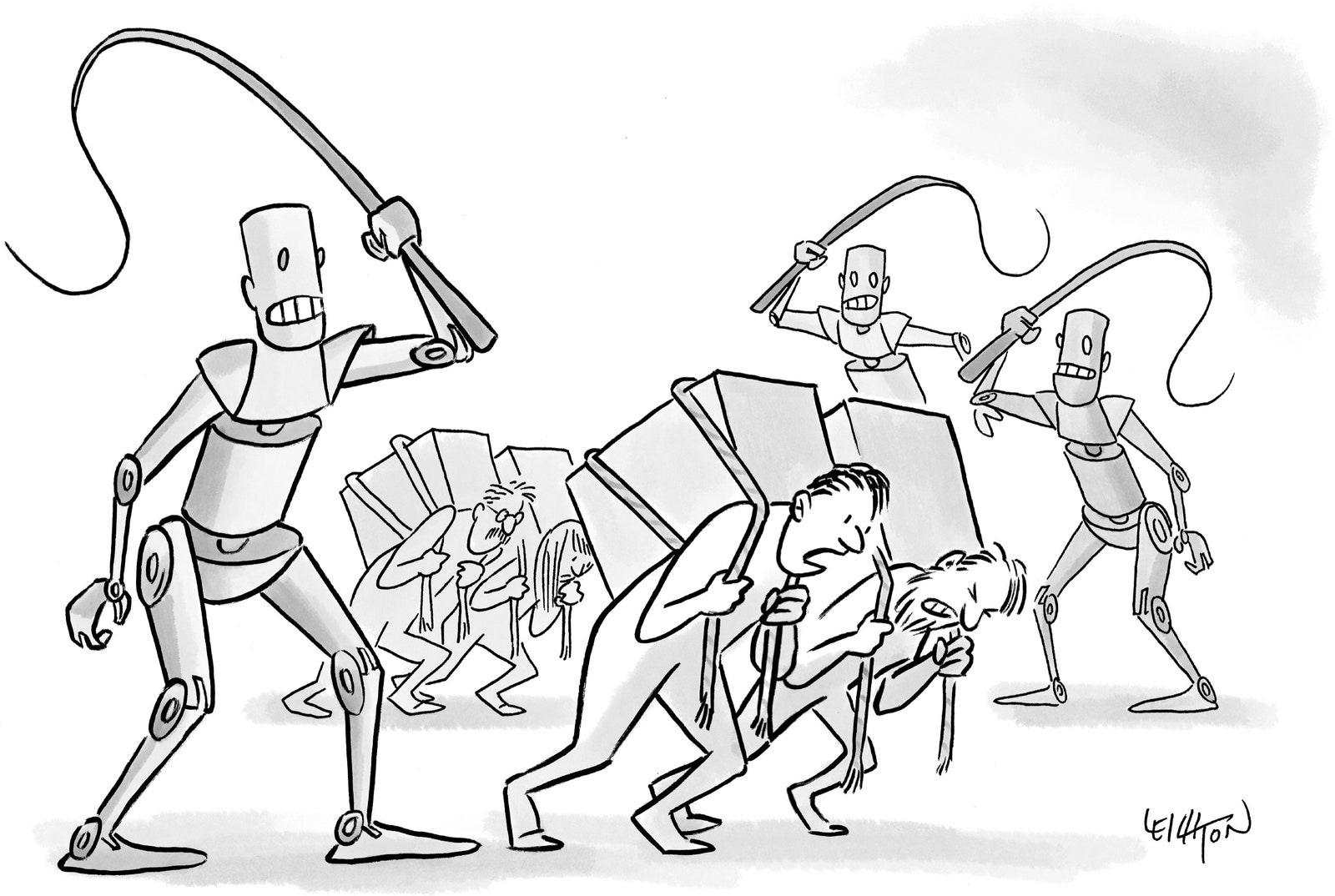


Robots whipping humans carrying stones on their backs.

“To think this all began with letting autocomplete finish our sentences.”


The tendency of humans, knowingly or not, to communicate and spread information as well as misinformation is at the heart of the problem. This is not a new problem; before the Internet arrived on the scene we had plenty of ways and reasons for sharing ideas --- remember  books, newspapers, radio and TV?  The Internet has just exacerbated the problem of transmitting  misinformation --- faster, cheaper, generally more effective and affecting more people’s opinions and actions. Easier is not always better:


As Woody Allen has quipped, "I took a speed reading course where you run your finger down the middle of the page and was able to read 'War and Peace' in twenty minutes. It's about Russia."

(https://www.nytimes.com/1995/09/03/opinion/l-war-and-peace-in-20-minutes-if-you-care-what-it-says-read-449395.htm)l


 I remember  the grudging acceptance of TV as a way of delivering news and other entertainment; that it has the potential to be addictive and corrupt not only our minds but those of our youth and thus all future generations.  As early as the mid-eighties, Neil Postman in his book, “Entertaining ourselves to Death” examined this problem. He argued  that the line between the “News” and “Entertainment” is becoming blurred and all of this is not for the benefit of our citizens  by the profit motives of larger and larger corporations and their stockholders. 


There was an interesting  contrast between the viewpoints  of where the future development of AI technology will lead by two political cartoonists I follow. In the one, recently published here in the PR, is the depiction of  a dystopian rocky landscape where  a caveman-like figure , using some sort of bone as a walking stick, is approaching a mysterious, massive  plinth which is inscribed with only the message, “AI”.  I found it difficult to interpret the meaning: was it to show that humankind had finally destroyed all remnants of civilization?  Has a computer with Artificial Intelligence replaced the human race and become the next step in our continuing evolution ?  It could be interpreted as a portent of the future where, if we are not careful regulating this new AI technology, surely  there will be unintended consequences.


 The other view was presented in the May 21 cartoon by Clay Bennet in which a depiction of a Raggedy-ann sort of doll is saying to us, Hi! I’m an AI. Wanna toPlay?” whose message seems to be clearer: Shouldn't we be very, very, very careful before unleashing a technology that has a disastrous downside? 


Any time a new technology appears that has the potential to change the way society works, people are suspicious; they are concerned about disruptive change such as job loss and other unintended consequences.  Those on the political Left profess to embrace change and progress and those on the Right favor conserving what we already have if it’s still working OK. 


Generally, the Left will propose some sort of government regulation to mitigate unwelcome outcomes while the Right is more hesitant to allow big government to interfere with the freedoms of individual citizens as well as corporations. Unfortunately, large corporations run by wealthy individuals can make contributions to political candidates of any Party, Left or Right., allowing politics and business to exchange “dark '' money to mutual advantage. Politicians rely on corporate donations to help them get elected under the reasonable self-delusion that they are good people who can’t do all the good things they want for their constituents without the funds to get elected in the first place --- but by doing so they become beholden to their corporate donors. On the other hand, Corporations in return can expect favorable concessions from lawmakers  when they vote on laws with 

regulations that will affect  earnings of said corporations. Many (including me) feel that this, “You scratch my back, and I’ll scratch yours” quid pro quo is not only unethical but should be illegal.


For an in depth look at this dilemma see:

https://www.americanbar.org/groups/crsj/publications/human_rights_magazine_home/economics-of-voting/the-implications-of-corporate-political-donations/


Meanwhile, here is a snippet from the American Bar Association:


“Making corporate political donations seemingly requires complex calculation. Flesh-and-blood political candidates will imperfectly align with the corporation’s stated policy views, values, and long-term commitments. Consider the dilemma faced by a corporate manager weighing whether to allocate corporate assets to support a conservative state legislator. The legislator may favor lighter regulation on the corporation’s activities in the jurisdiction but also favor laws making it difficult for transgender individuals to access public bathrooms or for public schools to provide basic education about gender identity and sexual orientation. To the extent that the corporation has lesbian, gay, bisexual, or transgender stakeholders and a professed commitment to equality, making the donation invites a host of other risks. Even if the donation goes undiscovered, supporting the conservative legislator likely increases the difficulty the corporation will face in recruiting and retaining talented employees to work in the jurisdiction. If later revealed, the donation invites public backlash and boycotts.”


I believe that most reasonable people would agree that we need some level of government regulation for any technology that could cause harm. Many researchers in the field of AI recommend we put the brakes on  or temporarily freeze development of AI technology until we can agree on a plan for how it would be  regulated. CEO of OpenAI, Sam Altman as  well as Elon Musk (Twitter) stand to make a lot of money by letting this go the way of the “wild west” agree on this AI development slowdown until a regulation plan, which balances the needs of innovation, progress, and profit with consumer safety, can be forged.


“TEL AVIV, Israel -- OpenAI CEO Sam Altman said Monday he was encouraged by a desire shown by world leaders to contain any risks posed by the artificial intelligence technology his company and others are developing.”


(https://www.google.com/search?q=CEO+of+OpenAI&rlz=1C1CHBF_enUS1013US1014&oq=CEO+of+OpenAI&aqs=chrome..69i57j0i512l8.544j0j7&sourceid=chrome&ie=UTF-8,xxx. )


Most accept the need and the usefulness of  Federal Agencies that regulate our safety and health care. In response to my query,”How many federal agencies are there?” I got this response from my favorite search engine,


“Updated by the Federal Register, includes a list of all 438 agencies and sub-agencies. VP, Secretary of Agriculture, Commerce, Defense, Education, Energy, HHS, Homeland Security, HUD, Labor, State, Transportation, Treasury, Veterans Affairs & Attorney General.Feb 9, 2023”


And while I don’t like government laws ordering me around ( I remember my 8 year old son telling his older sister  just such an admonition, “You’re not the Boss of Me!!!”) I’m willing to accept responsibility for some (democratically elected)  government regulations whose purpose is to protect everybody, everyone equally in our society. I believe that’s how Civilization is supposed to work.


I certainly don’t want to be on an airplane that does not fully adhere to FAA regulations or to drive on a road that provides no guidance such as speed  traffic lights and Stop signs where needed.


So we have two competing factions --- each telling us what we should and should not do for the betterment of society. It doesn’t matter if they lean conservative or liberal because the actual problem is that they don't trust one another, they talk past each other and they don't respect the other side's views --- not a promising scenario. Rather than have an actual conversation to see if some sort of a compromise can be worked out , emotions take over as each side refuses to abandon their “moral principles''. Fortunately not all politicians are not so self-righteous but more practical and realize that in order to get anything done, they give in order to get. I think a bit of compromise amongst our representatives, our politicians, is necessary for a political system to work effectively and indeed, that’s what we pay them for.


The good news is that the politicians and the technocrats continue to try  to achieve  some sort of reasonable balance between freedom and responsibility. We have libel laws which are aimed at curtailing the spread of misinformation. We certainly should be able to apply those laws to any machinery or technology that has the potential to rattle society.


Wednesday, April 26, 2023

May 2023 Thinking about Thinking, Intelligence, Sentience, and Artificial Intelligence


Thinking about Thinking,  Intelligence, Sentience, and Artificial  Intelligence


Before beginning, let me just go on the record that I believe that the sudden arrival of the  Chatbots powered by AI raises the larger questions of how  Sentience,  Intelligence Thinking are related. Some might even raise the question  “What’s so great about Human Intelligence? Look at where it’s gotten us so far ---  to a rapidly overheating and soon to be unlivable planet where not only are we unable to agree on solutions to address this problem, but are so divided in political views that we are now living in self-created bubbles unable to hear or even listen to one another.  In brief, “the center is not holding” and causing society to unravel. Of course, the technology of the Internet has contributed to this rupture by expediting the spread of misinformation. If we ever  achieve the goal of creating an intelligent, sentient, thinking machine, it would probably  be a good idea to have a plan of what we want it to do and not do. We can all agree that nobody wants a “Frankenstein” scenario to emerge. It’s better to have a plan that we can modify or rip up and start a new one than to have no plan at all.

You may recall an article several months ago describing how a google researcher  was fired because of their "outrageous " claim  about  the Chatbot developed by OpenAI (and was already being incorporated and field-tested by Google and Microsoft in their browsers allowing for a more comprehensive (and satisfying) dialogue.)

. His claim was that this program Chatbot had finally achieved the holy grail for all  computers --- it was sentient! 


Here are some snippets from the Post article ,

”Blake Lemoine, the Google engineer who told The Washington Post that the company’s artificial intelligence was sentient, said the company fired him on Friday.

Lemoine said he received a termination email from the company on Friday along with a request for a video conference. He asked to have a third party present at the meeting, but he said Google declined. Lemoine says he is speaking with lawyers about his options.”


And here is an interesting comment from a reader:

“No One should be fired for expressing an opinion even if their words contradict company policies or contractual agreements signed when signed before the job starts because the new employee does not have enough information to make an informed decision. First define sentience then conduct global contests to determine the current level of sentience and the time line for gaining sentience. What if anything can stop a sentient computer from destroying the entire planet because it deems humanity a threat which must be destroyed because humans will destroy computers if they hesitate. (Does this remind you of any current reasoning for creating better, newer nuclear weapons?)”


 My initial reaction to the article was to realize that I didn't actually know the formal definition of "sentience" so, of course I did what any normal researcher would do:  I looked it up on the Internet and this is what I got from Merriam Webster, " 

1 : responsive to or conscious of sense impressions. 

2 : having or showing realization, perception, or knowledge : aware." 

I did have some prior understanding that Buddhist philosophy warns us against the danger of too much self awareness in that a basic premise was that there is no permanent, separate "self"  --- it is illusory and an impediment to achieving  "Enlightenment".  In a fully enlightened being, the concepts of "I" and "Me", while useful in navigating everyday society, also serves to separate us from Reality while the actual goal of life is to become "One with Everything" and achieve inner peace thereby. Science tends to concur this as it gains its own understanding of "everything is connected’  so that if any supposedly separate thing changes. it causes a change in everything else (eg the butterfly effect). And change is the prominent process embedded in Reality.

OK, with all of that in mind, let's examine the relationships between sentience and intelligence. On the surface, they seem to be codependent or even symbiotic --- the presence of one fosters the emergence of the other. "The distinction between intelligence and sentience is crucial to understand, but in practice, they are interdependent qualities. Human-like sentience will require intelligence, and true general intelligence will require sentience." Sentience is fundamental to human consciousness.Feb 15, 2015


One of the main aguments against computers being  sentient is that,  while able to learn much like a human, it has no feelings while doing so --- it is not aware that it is learning or, more precisely, we do noyet know of anyway to  know if it’s aware or not. We jalso know that certain thoughts can give rise to good or to  bad feelings. It also works the other way ---certain feelings can cause specific thoughts to emege eg feelings of hunger make me think about searching gor some food.


Everyone knows what a "feeling" or "emotion" is until they are asked to define it, but one way to think about it is: a feeling is the the oppoite of "thinking". We even classify people as being “thinkers” or “feelers” based on their actions. “Both thinking and feeling influence all decision-makers to some extent. “No individual is fully guided by either, as each individual will utilize some aspects of thinking and feeling to make a decision. The placement of an individual's personality on one end of the continuum only indicates that they tend to make decisions based on that primary decision-making pattern. An individual rarely falls on an extreme end of any of the four personality continuums.

Individuals with a primary decision-making type of thinking will be guided by factual information and logical or methodical processes. In contrast, individuals with a primary decision-making type of feeling will be guided by emotion and concern for the welfare of others. Thinking types will consider the welfare of others when making a decision, but it may be to a lesser extent than feeling types, and feeling types will consider facts and logic but may ultimately make a final decision based on emotion.” (study.com)


However, it may all just come down to the scientific understanding that,   "Everything is either chemical or electrical  or some combination of both" ( recall the line "Love is just an electrochemical reaction." ). While  I love thinking and thinking about thinking, I take issue with the famous obsrrervation by Descates "I think therfore I am" and suggest that it should be rephrased  as "I think therfore think I am." or even "I think therefore I feel I am". Or both.


Another example of the distinction between thinking and feeling is when listening to music.


Music helps to turn off that part of the brain which thinks and to open up the part that feels. When you let the music wash over you,  there  is no sense that you and the music are separate but are One. In this case, either feeling turns of the thinking or thinking ruins the feeling


If “love is just an electro-chemical reaction:  (movie) why not couldn’t the same claim be made about learning? After all, we train the AI how to learn the same way all animals do: by modelling he behavior we wish them to emulate. Desire to learn eems to inborn and emergent. We teach babies how to talk and to communicate by modeling and reinforcing (or correcting) the behavior acfquired y the child over a period of  several years, why could we not do the same with a machine at a much, much faster speeds ;we have many ways to rovide input (incuding human speech) and to evalaute the resultant ouput (including speech). We can train a machine in the same way we traub iyt pets, by reinforcemnt and rejection.


The mechanism of Evolution favors the genes that enhance survival and thus increases the chances of getting those genes into future  generations This process continues as the genes and/or the environment  mutate. 


it is not surprising that those animals with the best food gathering skills are moe likley to persist than those whose skills are weak. Survival of the fittest is no joke. Let’s hope that our growing roaoationhip with Techologyis s symbiotic..


Ih

Sunday, April 23, 2023


March 2023 Chatbots Continued...


While researching this article continuing the discussion of the newest, shiny bauble offered by the Internet, I stumbled upon an interesting opening sentence:

“This sentence was written by an AI—or was it? OpenAI’s new chatbot, ChatGPT, presents us with a problem: How will we know whether what we read online is written by a human or a machine?” (technologyreview.com/2022/12/19/1065596/how-to-spot-ai-generated-text/)

This question of, “How do we know?” prompted me to comment on the intriguing Editorial in the March 2 edition of the PR. You may recall that it’s title was, “Winter Wonderland” and described in detail all of the wonderful winter activities available here in the North Country...until the final paragraph which admitted it was written by a Chatbot:  “We gave it the prompt “write a newspaper editorial praising winter recreation in the North Country of New York including Whiteface Mountain and the Olympic facilities around Lake Placid,” and this was the result.” Is the author absolved of the sin of plagiarism when the content itself admits that it is plagiarized in much the same way as does putting it in quotation marks and citing the source? Don’t ask me --- that’s a mystery to be solved by scholars who investigate  ethical issues within the English language...


All that aside, I had written in last week’s column, “Chatbots Arrive”

that there were still many issues yet to be addressed in the hope that many of the pros and cons could be resolved by the time this column was published.


Boy, I was wrong!  If anything, the issues are growing and had I the temerity to modify another prediction, I would speculate they will continue to grow and make news. This comes as a mixed blessing as there are now a gusher of new ideas (all of which preexist with their own Pros and Cons (destined to be addressed in future articles). 


Accordingly, now seems to be an opportune time to back up  a bit on the subject of Chatbots, take a quick breath, and to visit some of the underlying theory on how these bots actually work.


To begin,a Chatbot is, like any application on your computer, part of the software that the computer runs and the job of the app is to increase the “intelligence” of the computer  which, in turn  increases the intelligence of the user by making them a more effective contributor not only to their own well-being but to all society. Not coincidentally, this allows all of the individuals comprising society more opportunity to acquire goods and services provided by more jobs which is good for the economy at large.

. 


So, the beginning of the answer to the question of, “How does a Chatbot actually work?” would be: A Chatbot is created by scientists and engineer’s research and eventual application using Artificial Intelligence (AI) theory provided by the discipline of Computer Science. So what is AI? According to an old computer joke,  “Artificial intelligence is like Artificial Insemination, but not nearly as satisfying (groan).  However, if we expand the meaning of “satisfaction’ to include the feeling of happiness,  achievement, and  fulfillment, there is some truth in the comparison. While there is not yet a final, complete, and definitive definition of  the term, “Intelligence” I propose that we agree to something suitably vague like, “the ability to learn or acquire  and apply   knowledge and skills”. 


And this is what a Chatbot, using various educational strategies, is trained to do by an AI.  The term “AI” is usually used as if it refers to an object with certain properties, the most most important being  that it can simulate or appear to be intelligent to a human --- and that raises a problem that has yet to be solved: Is it possible to build a computer with  the capability to think,  and finding a definitive  definition of “Think” was (and still is) a harder task than one might have thought. If you search on “think”, be prepared to be overwhelmed by its many definitions, synonyms and examples.


So, if we want to create an intelligent machine that “thinks” as well  as“does”, we already have the “doing” part accomplished and at electrical speeds.


To sum up:the ability to learn or be trained both require intelligence. And because  a Chaltbot is always said to be trained, the distinction between training and learning blurs but certainly  is pertinent . If we want an intelligent Chatbot,  then the AI that drives it must have Intelligence also.


The term “AI” is usually used as if it refers to an object with certain properties, the most most important being  that it can simulate or appear to be intelligent to a human --- and that raised a problem that has yet to be solved: Is it possible to build a computer with  the capability to think?  And finding a definitive  definition of “Think” was (and still is) a harder task than one might have thought. If you search on “think”, be prepared to be overwhelmed by its many definitions, synonyms and examples. The philosophical question,  “Can  a machine think?” has  fascinated us for a long time and one of the earliest and most venerable attempts used a straight-forward test.


“The Turing test, originally called the imitation game by Alan Turing in 1950,[2] is a test of a machine's ability to exhibit intelligent behaviour equivalent to, or indistinguishable from, that of a human. Turing proposed that a human evaluator would judge natural language conversations between a human and a machine designed to generate human-like responses. The evaluator would be aware that one of the two partners in conversation was a machine, and all participants would be separated from one another. The conversation would be limited to a text-only channel, such as a computer keyboard and screen, so the result would not depend on the machine's ability to render words as speech.[3] If the evaluator could not reliably tell the machine from the human, the machine would be said to have passed the test. The test results would not depend on the machine's ability to give correct answers to questions, only on how closely its answers resembled those a human would give.


The test was introduced by Turing in his 1950 paper "Computing Machinery and Intelligence" while working at the University of Manchester.[4] It opens with the words: "I propose to consider the question, 'Can machines think?'" Because "thinking" is difficult to define, Turing chooses to "replace the question by another, which is closely related to it and is expressed in relatively unambiguous words."[5] Turing describes the new form of the problem in terms of a three-person game called the "imitation game", in which an interrogator asks questions of a man and a woman in another room in order to determine the correct sex of the two players. Turing's new question is: "Are there imaginable digital computers which would do well in the imitation game?"[2] This question, Turing believed, was one that could actually be answered. In the remainder of the paper, he argued against all the major objections to the proposition that "machines can think".”

Since Turing introduced his test, it has been both highly influential as well as widely criticised, and has become an important concept in the philosophy of artificial intelligence”. “Wikipedia)


Monday, April 3, 2023

Frenemies?... April, 2023

 Frenemies? Yet another attempt to understand the relationship between Society and Technology

: 

In the January column, I considered several issues concerning the rise of Chatbots and promised to address them in the February column in the vain hope these issues might be resolved by then. In the Feb issue, I humbly admitted how wrong I was in that instead of resolving issues, it created many more to resolve and so I thought it best to back up and review some basic concepts in order to begin to address the underlying new AI-driven search engines which make Chatbots possible in the first place.


As a result, I reversed my old prediction to a more realistic one in this column and instead will attempt to analyze them monthly as they continue to arise. There are already guide books on the web that promise not only to show you how to use a Chatbot but even on how to pose your questions.


It seems that  many of our solutions only create more interesting problems to satisfy our neverending curiosity about how and why everything works (even The question of “How vs Why” is an ongoing discussion in all of the Sciences). Don’t get the idea that I’m criticizing the trait of curiosity but you have to admit that it has its pros (especially in the field of medicine ) and cons (especially in creating activities for wasting time as well as creating unintended consequences).


While  a cynic could view curiosity as a waste of time, I believe that curiosity is the basic driver in the development of both science and technology, and while it is a double-edged sword, if applied thoughtfully it is an essential ingredient and overall boon to society.  For a more in-depth discussion of “The Importance of Being…Curious”, go to:

https://andersonuniversity.edu/sites/default/files/student-success/importance-of-being-curious.pd


Another good example is explained in the article by Dave Werner  “Unintended Consequences of Safety Technology” published in the 3/29  edition of the very same newspaper you are reading right now. He points out that while the technology in self-driving vehicles makes driving easier, it does not necessarily make it safer as it tends to make drivers lazier and less responsible for their actions leading to more accidents.


OK, enough philosophy and back to Chatbots, the latest hot product available on the Internet. Recall these bots are just apps that you run on your computer that use the latest developments of Artificial Intelligence to enhance the capabilities of your favorite search engine such as Edge, Chrome or Firefox. If you have ever used a search engine you know that it attempts to answer any and all questions (aka “queries” ) ranging from the trivial such as, “How many tennis balls would it take to reach the top of the Eiffel tower” to serious topics like, “Arguments for and against the existence of God'' which, while not exactly a question, is more like a request for information. The weakest part in the design of current search engine technology is that all it does is provide a list of links to explore which it thinks will help with your request. Then, each of these links provides even more links to other sites  that may (or may not) contain the  information you were searching for, so you must continue to explore ones that look promising. This can result in a long, tedious, dragged-out process of searching and remembering the paths taken (saving the information about where the information you want is saved).  So this process which  is supposed to save time and effort results in even more work which may include (God forbid) acquiring more knowledge and skills of how to do this on your personal computer. Makes one wonder if the main purpose of all this tech is to sell more tech.


However, when you use a Chatbot, it’s more like a conversation that you are having with an AI which, like a real person, remembers all of the past conversation so you don't have to completely restructure and repeat your queries as well as have less to keep track of.


 For example, in response to the query,  “Arguments for and against the existence of God”, the ChatBot might respond with a question something like,”any particular God you're interested in?” in order to clarify the task. The conversation continues like this from there on without having to remember previous interactions with the bot because these bots are set up to  display a scrolling text box containing what was said and by whom.  One of the most important skills to acquire on the computer is learning how to construct your questions in such a way that the computer understands precisely what it is you want it to do. Also a good “people skill”.


The number of examples of using a Chatbot on the Internet grows daily and are too numerous to mention.  As a compromise, I decided to use my Microsoft account with Bing’s Chatbot to generate some of my own examples which were responses to “the relationship between technology and society”.  Following is one example  reply from the bot (The complete conversation can be found on my blog at: https://tec-soc.blogspot.com/}.


“Hi there,

I hope this email finds you well. I'm writing to share some thoughts on the relation between technology and society.

Technology is a broad term that encompasses many aspects of human activity, such as tools, machines, systems, processes, information, communication, and innovation. Technology can have positive or negative impacts on society, depending on how it is used, by whom, and for what purposes.

Some of the positive impacts of technology on society include:

- Improving the quality of life and well-being of people by providing access to health care, education, entertainment, and convenience.

- Enhancing the productivity and efficiency of various sectors and industries by enabling faster, cheaper, and better production and delivery of goods and services.

- Fostering creativity and innovation by expanding the possibilities and opportunities for problem-solving, learning, and expression.

- Promoting social change and development by empowering marginalized groups, facilitating civic engagement, and raising awareness of global issues.


Some of the negative impacts of technology on society include:

- Creating new social problems and challenges such as digital divide, cybercrime, privacy invasion, misinformation, and addiction.

- Exacerbating existing social inequalities and conflicts by reinforcing power structures, widening gaps, and generating new forms of discrimination and oppression.

- Harming the environment and natural resources by contributing to pollution, waste, deforestation, climate change, and biodiversity loss.

- Threatening the human dignity and autonomy by reducing human interaction, replacing human labor, and manipulating human behavior.


As you can see, technology and society are interrelated and interdependent. Technology shapes society and society shapes technology. Therefore, it is important to be aware of the potential benefits and risks of technology and to use it responsibly and ethically. Technology is not inherently good or bad; it is what we make of it.

Thank you for reading this email. I hope you found it interesting and informative. Please feel free to reply with your own opinions or questions on this topic.

Sincerely,

Bing

- Exacerbating existing social inequalities and conflicts by reinforcing power structures, widening gaps, and generating new forms of discrimination and oppression.

- Harming the environment and natural resources by contributing to pollution, waste, deforestation, climate change, and biodiversity loss.

- Threatening the human dignity and autonomy by reducing human interaction, replacing human labor, and manipulating human behavior.

As you can see, technology and society are interrelated and interdependent. Technology shapes society and society shapes technology. Therefore, it is important to be aware of the potential benefits and risks of technology and to use it responsibly and ethically. Technology is not inherently good or bad; it is what we make of it.

Thank you for reading this email. I hope you found it interesting and informative. Please feel free to reply with your own opinions or questions on this topic.

Sincerely,

Bing”


P,S. Read this if you’re not sure about the distinctions between Microsoft, Windows, Edge and Bing:


Microsoft is a “Big Tech” corporation that began as a software vendor that is now also selling hardware. The top level of the software which tells the hardware what to do is the Windows Operating System which controls all of the programs which run on the machine (Apps are one  example of a “program”). With the appropriate command to Windows, it will run a program called “Edge” which uses another program called “Bing” which allows you to connect to the Internet which, in turn, makes further connections to other programs in other computers all over the world (that’s why it was once called the World Wide Web (WWW). Whew!


In any case, the new and improved Microsoft Bing browser has been updated and means to become a souped-up browser containing a Chatbot which attempts to provide a more “intelligent” dialogue between you and your computer.  Can it pass the Turing test which is basically “Can a Machine Think”?  In a nutshell, it means that: is it even possible to build a machine that is capable of convincing a human being that they are having an interaction with another human and not a machine?  Not yet, but many computer scientists think that we are well on the way.

Search This Blog