Observing Thinking

Observing Thinking
Observing Thinking

Tuesday, December 7, 2021

Government vs Private Enterprise Consumer Privacy Protection: Pros and Cons

 Government vs Private Enterprise Consumer  Privacy Protection: Pros and Cons


This title is quite a mouthful, so let me attempt to explain:.


The latest Amazon kerfuffle has raised a more generalized question.

Last month’s column mostly discussed the issue of Internet privacy and may have left the impression that privacy is inherently a good thing as well as a citizen’s right. However, it raises a thorny issue: how to provide and enforce that right?  Can it be done with a cooperative effort by the service providers as self-watchdogs or should the government be the watchdog and provide the protection?


Like most thorny problems there are pros and cons to alternative solutions. An advantage to government regulation is that it is set up to be fair and impartial and we are protected under current interpretations of the Constitution and including its amendments known as The Bill of rights.  This can be a pro or con for Internet providers as well as service providers as they would have conflicting goals: on the one hand, most may really wish to provide privacy protection for their users but at the same time and, as anyone who has been watching the TV series “Billions” knows, corporations must make profits for their stockholders (and consequently themselves) and offtimes attempt to avoid the law in order to do so. 


Unlike the government, corporations are not elected by the people, so the government handling the issue is another plus for the government. On the other-other hand one can argue that the government has a history of being sluggish, costly and is prone to overreach making private enterprise the wiser choice. Clearly some sort of balance between the two should be worked out. Unfortunately, it is not a trivial task to balance what people say they want from a democracy to deciding how to provide that service  --- which is either through the auspices of the government or private enterprise. It isn’t even an exclusively one versus the other situation as it could also blend the rights and responsibilities of both. 


What about AI or Artificial Intelligence as a solution? It seems to be becoming a panacea for many other seemingly intractable problems. But using AI to help ensure privacy and security is also not as easy as it might seem.  AI is getting better and better at detecting and censoring hate speech but can it detect and block viruses and malware from taking over the computer’s built-in Operating system or OS?  


Oversimplifying, the OS is the boss of everything; it decides which components of the hardware will do what and when to do it. Perhaps “decide” is too much an anthropomorphic analog but the OS such as Microsoft or Chrome  (which to many are the Internet) are just programs written by programmers at a very detailed level called Machine Language that gets assembled into a format the hardware can “understand” and execute. 


Now suppose the programmer who wrote the program to steal or destroy data is smarter than the programmer(s) who wrote the OS.  It’s not going to be a happy scenario for users of the OS --- it becomes a game of cops and robbers where sometimes the cops win and sometimes the robbers get away with it. In other words, get over it or at least get used to it --- the struggle between good and evil has been a wrestling match for a long, long time.


There are three choices here: The government regulates, private industry regulates itself, or some hybrid model whereby regulation responsibility is shared. 


“One key lesson is that regulators should not be afraid of looking dumb and asking 'stupid questions'.  If something is unclear, or doesn't feel right, then you might well be close to learning something that the regulated entity doesn't want you to know. The classic example was the FBI's failure to follow up on their agents' reports that some trainee pilots had asked to be shown how to fly a plane, but not how to land it.  The result was 9/11.” (https://www.regulation.org.uk/reg_effectiveness-homepage.html”)


Once the dilemma of choosing the government, private enterprise or hybrid regulatory framework ,we would of course, have to name this agency and choose a suitable acronym for it because that’s how it works. For the sake of simplicity let us assume that we have chosen the Government-only Regulation option.


So first, what would we call this suggested “Internet Protection of Privacy and Security Agency'' ? The thought comes to mind that the simplest abbreviation is best: IPPSA. It even looks like it might be a pronounceable word (ippsuh) like many abbreviations for government agencies.  But wait, before we commit to an acronym,we must search through all of  the existing ones to make sure that we do not unwittingly reuse  one. Does there exist a list of all the agencies somewhere in the dusty corners of the Internet?  Of course. 


All one has to do is fire up their favorite Search Engine app to look for it.  When I enter the phrase “US GOVT agency acronyms” I got back a list of brief results from Google and chose the first one: https://govinfo.gov mainly because I trust websites that have the “.gov” suffix.   I got 8 pages of hits in a nice two-column table. The results range  from  ABMC standing for the AMERICAN BATTLE MONUMENTS COMMISSION to WHD for the Wage and Hour Division, whatever that means. ( I’m sure your search engine can find out.)  After a semi-intense scrutiny, we find that our proposed IPPSA choice would fit right in with no conflict). We could shorten it even further by dropping the “A” at the end to make  IPPS easier to pronounce. If you do venture to the website, it’s hard not to to get sucked in to browse the list finding edifying acronyms; for example, OJJDP stands for the  JUVENILE JUSTICE AND DELINQUENCY PREVENTION OFFICE  even though the “O” for Office seems to be misplaced. 


Monday, October 18, 2021

 The Privacy Problem Revisited 8/14/2021


 Many of us would be annoyed by the divulging of our  private information such as where you live and many others would rationalize, “Well, if I have to get these ads to support the services provided by this site, then I’d rather they be targeted to my interests instead of a random choice --- either way I’m going to get the ads so that I won’t have to pay for the services the website provides. So the choice becomes: do I want to pay for the use of the website (like any other commodity) or do I pay by sharing some of my personal information? To paraphrase an old saying that sums this up, “When a website claims to be “free” you are the customer and you pay with your private information”.


In my experience, the younger generation is less concerned with protecting their privacy than is the older generation and the older you are the more the concern. During the early days of the Internet a story circulated about a fellow on the subway handing out forms that, when filled out, would capture much of the rider’s personal data. What was the gift to the riders for providing this information? A cheap plastic ballpoint pen. So, if you’re willing to give up your privacy for a cheap pen, it would seem to follow that you would do the same in return for the services of a Google search engine or a social platform such as Facebook.


An article by Cameron Summerson summarizes the argument for using Google and Facebook and paying with personal data. 

https://www.howtogeek.com/353483/why-its-not-a-big-deal-that-google-and-facebook-knows-a-lot-about-you/ (If you don’t want to type that long URL, it might be simpler to search on “why it’s not a big deal that google and facebook knows about you”).


In a nutshell, he argues that you are not selling your personal data to the two tech giants.  At best, you are leasing it to them in return for using the services the giants provide. Besides , he argues, Google and Facebook provide very strong security for your data (which makes sense because it is valuable to them.). Likewise, the advertiser who pays Google and Facebook to display his advertisement in your searches or feeds has a self interest in providing strong security for your data keeping it safe and private for the same reason --- it is valuable. Once the user clicks on their ad and is taken to the advertiser’s website then any information that you give about yourself is your own personal choice. And finally both Google and Facebook as well as most Big Tech companies claim that  the data is anonymized before being distributed. “ Data Anonymization” is defined as a "process by which personal data is irreversibly altered in such a way that a data subject can no longer be identified directly or indirectly, either by the data controller alone or in collaboration with any other party." (Wikipedia). So the question becomes do we take Google and Facebook at their word?  Can they really keep our data private? But even if we choose to trust them, to  make matters more complicated, it is possible for a hacker to de- anonymize  the anonymized data to the point where your identity is discovered! “De-anonymization is the practice of matching anonymous data (also known as de-identified data) with publicly available information, or auxiliary data, in order to discover the individual to which the data belong to. “ (Wikipedia)


However, to make matters even more complex, de-anonymization is not foolproof and the name of the person can be found using simple computer techniques. For example,

” Mr. X lives in ZIP code 02138 and was born July 31, 1945. ... narrows down the population, so much so that the combination of (gender, ZIP code, birthdate) was unique for about 87% of the U.S. population. ... show that people can potentially be re-identified by these kinds of data, not that everyone will be.” (https://www.eff.org/deeplinks/2009/09/what-information-personally-identifiable)


By now you might be asking: how is all this head-spinning information useful to me?  We  protect our privacy by reading  what  the experts have to say; if you search on the phrase “how to protect my privacy” you will be rewarded with a plethora of sites to visit that provide advice.  In fact I made this search and was impressed by an article in Time Magazine  entitled “11 Simple Ways to Protect Your Privacy” by Christina DesMarais.  She makes suggestions that range from  “Don’t fill out your social media profile” to “Lie when setting up password security questions”. Although these sound counter-intuitive, if you search on the title to the article, DesMarais explains why these are reasonable precautions.


How to protect our privacy is not a new problem spawned by the Internet. The issue has been around for at least 100 years. “Lewis Brandeis and his law partner Samuel Warren published “The Right to Privacy” in the Harvard Law Review in 1890, where it became the first major article to advocate for a legal right to privacy.” (Wikipedia)


Brandeis succinctly summed up his beliefs in the much-quoted phrase, “ Privacy is the right to be let alone” He was right over 100 years ago and he is right today.


Thursday, July 8, 2021


Desktops and Laptops and Tablets and Cell phones, O’ My


While chatting with a friend we got to talking about phones and he remarked that he liked the old phones (circa 60s) mainly because they were much simpler to use ----the phone rings and you pick up and start to talk immediately and not have to tap a bunch of virtual buttons in order to accept the call and speak. I responded that it was something like a Swiss Army knife being multi-functional. It was a knife, a bottle opener, scissors, nail file etc. but it was not a very good knife,scissors  etc. --- adequate but not really good. Single function tools are always better as well as simpler.Well,it turns out the modern phone has become a multi-function tool so as a phone it’s not the best ---  it’s actually a mini computer so it can perform operations that can be programmed and offered as an application. As a result, the phone app usually leaved a lot to be desired. Of course, one could argue that a modern smartphone has many useful attributes such as keeping a shopping list and keeping a list of contacts handy as well as acting as an alarm clock, a calendar,or anything that requires a list. 


Shortly thereafter, I ran across an  article in the June 19,2021 WSJ by Christoper Mimms entitled,” ““”Why PCs Are Turning Into Giant Phones “ which seems to be saying the exact opposite to what I claim but , if you think about it, it is saying the same thing: namely that the functionality of the PC (Personal Computer) and the cell phone are converging. After all, isn’t that 4 oz cell a tiny computer? If it can perform all the normal operations that a computer can then why isn’t it at least a computer? Mimms goes on to say “For everyday tasks both at home and at work, we have long had a choice: pull out a heavy brick with a noisy fan, a pixelated display, a few hours of battery life and a tenuous connection to the internet; or reach for that instant-on, alwaysl onnected, app-stuffed supercomputer in our pockets.”


According to Intel group, “...the right choice depends on how you're going to use the device. The general division between computing devices is still based on where you use it:

  • Laptops suit on-the-go users. They combine hours of battery life with the performance and responsiveness to power immersive experiences that keep you productive wherever you go.

  • Desktops are ideal for power users. They offer more processing power at a lower cost and are easier to upgrade, repair, and customize for your ideal computing experience at home.”


You might say that it’s a tradeoff between power/cost and convenience. In either case, many single-purpose machines continue to be replaced and enhanced by digital devices. We have come a long way from computers that filled a room and needed their own air conditioning systems to function. As computer programmers we submitted our jobs (Fortran programs) on punch cards where they were processed first- come/first-served by the humongous IBM or Univac computers  (I remember lifting a panel of the false floor supplying the cool air  to keep my lunch fresh). Currently I have an Alexa made by Amazon and a Portal made by Facebook which can communicate and so I  have speech recognition obviating the need for a keyboard as well as 2-way television to enhance social interactions. I can ask these devices such questions as: which country a tennis player is from (very important while watching Wimbledon). I can set a timer that I turn on and off with my voice, maintain a shopping list as well as play card games like Hearts and Rummy with my daughter in Iowa and my son in Albany.


Today we are promised “quantum” computers that promise to increase their speed manyfold. 

According to the site Redshark, “Quantum computers store information in the form of quantum bits, or qubits. Like Schrödinger's cat (which would not have had the colloquial impact had he chosen an inanimate object), qubits can exist in two different information states at the same time.”


 I don’t quite understand all this, but In any case this will allow us to run programs to solve previously intractable problems. An “intractable” problem from the point of view of computer science is one that cannot be solved generally for all cases because there are no known efficient algorithms to solve them --- in other words they can be solved but it would take too much time and computer resources. These problems are usually tractable for simpler versions of the problem but as their size increases, the solution time grows exponentially or factorially.


 Here is an example of an intractable problem from: https://www.trccompsci.online/mediawiki/index.php/Intractable_Problems


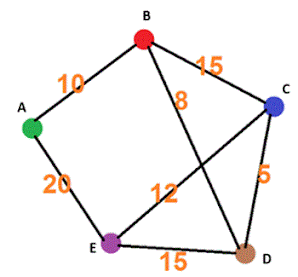
“One example of an intractable problem, you have to travel from the starting city to all cities on the map and back to the starting city, for the lowest cost. The letters (A,B.C,D,E in the diagram represent the cities to be visited. The lines connecting the cities represent the cost (e.g. the mileage between cities).


To calculate the number of possible routes, you can find the factorial of n-1 to tell you how many routes there are, however you can divide this by 2 because each route has an identical route in reverse:TSP.gif

So 5 cities will be: (4! Stands for 4x3x2x1)

  • 4! = 24

  • 24 / 2 = 12 routes


(For our 5 city example: if we visit each city in the order A,B,C,D.E,A we get a cost of 65 which is not optimum -- if we go A,B,D,C,E,A ---we can do better. Try it.


So 10 cities will be:

  • 9! = 362880

  • 362880 / 2 = 181440 routes

So 12 cities will be:

  • 11! = 39916800

  • 39916800 / 2 = 19958400 


WOW! That's almost 20 million paths to calculate for just five cities! 


There are many problems such as climate change which consist of looking at many interacting scenarios and need the brute force method (just trying every possibility) for solving them. According to https://interestingengineering.com, quantum computers are projected to solve the previously intractable problems concerning: Encryption and Cybersecurity, Financial Services,Drug Research and Development, Supply Chain Logistics, and Faster Data Analysis, and possibly the best ways of combating the worst effects of climate change.They also indicate that,“Quantum Computing just got desktop sized. Where it took a rackful of electronics to control the qubits, now it’s available on a chip the size of a penny...“All the functionality is on a chip, so we’ve solved the issue for the quantum era.”

Now, all we need do is make the navigation of an app simpler and easier to use.


Wednesday, May 5, 2021

 Copyright or Copywrong?


Every column that I write is derived from information published elsewhere along with my comments on that information. Most of the text you are reading is from me but portions are in “quotation marks” which signal to you, the reader, that I am appropriating another’s words (It can also indicate whimsey as when one uses “air quotes” to make a point.).


 In most cases, the original author of those words has copyrighted them in order to protect his or her ownership.  However, the original purpose of copyright was “To promote the progress of science and useful arts, by securing for limited times to authors and inventors the exclusive right to their respective writings and discoveries.”

(US Constitution Article I Section 8 | Clause 8 – Patent and Copyright Clause of the Constitution. ). 


Note that the phrase “To promote the progress of science and art” is the primary reason for a copyright law.  To protect the author or discoverer’s financial interests is secondary. In other words, individual rights are subservient to the rights of the people, to society as a whole. Since then, In order to balance the rights of the individual and the laws of society a compromise has been reached: the “fair-use” doctrine. It means that when an author uses another's words verbatim they must be enclosed by quotation marks as I did in the opening paragraph. There are also four more complicated requirements that must be followed in order to qualify for this as  a fair-use exemption, The two  most important requirements specify that you cannot  profit from it without an agreement from the owner. This usually means the owner will share any profit you make and the owner will not incur any costs as a result. It also means that you cannot appropriate too much of the material from the owner (the shorter the quote the better)  After all, it does not seem right for me to put your whole book in quotes and attempt to claim it as fair-use.


These requirements are discussed  in great detail these two websites;: 


https://fairuse.stanford.edu/overview/fair-use/four-factors/ https://www.copyright.gov/fair-use/more-info.html


As an example of fair-use I can use the following somewhat lengthy quote,


“On February 7, 2007, Stephanie Lenz posted a blurry twenty-nine second home video of her toddler on YouTube. In the video, thirteen-month-old Holden bobbed up and down on his rubbery legs, at his mother’s enthusiastic urging, to Prince’s 1980s hit Let’s Go Crazy while his older sister ran breathlessly around the kitchen table.

The song, playing in another room, was barely recognizable. But when Lenz uploaded her video to YouTube, she titled it “Let’s Go Crazy #1”—leading Universal Music Corp. to find it with a web crawler and send YouTube a takedown notice à la the 1998 Digital Millennium Copyright Act, which provided copyright owners with an efficient vehicle for quick removal of such content. For the next six months, anyone looking for the video—namely, Holden’s relatives—would find a black rectangle in its place, bearing the ubiquitous YouTube apology: “We’re sorry, this video is no longer available.”


Although the video was eventually reposted, Stephanie Lenz sued Universal in July 2007 for knowingly misrepresenting her work as copyright infringement and argued that her use of the “Let’s Go Crazy” recording was covered by the “fair use” doctrine..... At its heart is a crucial question: exactly how should the copyrights of content owners be balanced against the fair-use rights of those who post user-generated content (UGC) on Web sites such as YouTube—content that often contains copyrighted songs, film and television clips and other copyright-protected work mixed together with original work. 


The Digital Millennium Copyright Act (DMCA) ostensibly answered this question with its system of takedown notices which allow the owner of the content to. However, the Lenz case represents a challenge to that paradigm—one that argues for a fine-tuning of the law and the parameters of fair use.”


So, if I use this quote in my column as I already have done, then I must also indicate the source which is:


https://jitp.commons.gc.cuny.edu/lets-go-crazy-lenz-v-universal-in-the-new-media-classroom/


and in this case, explain how it is allowed under the fair-use law:  I do not profit from it and it does not diminish the value of the piece for the original author. If I did profit and it diminished the value of the piece then I would be breaking the copyright law.


The Lenz vs Universal court case had to decide who was responsible for determining whether fair-use was applicable . Universal claimed that it was not  t’s responsibility to make that determination. However, the court ruled that it was their responsibility to review the criteria for fair use before taking down (removing) the post and since Universal provided no such evidence, the EFF representing Lenz won the case establishing a modification of the fair-use law.  This case dragged on for ten years before Lenz won the suit.


To see the actual video just search on:  “Let’s go crazy #1 youtube”


Sunday, February 7, 2021

Is the Internet Responsible for our current Political Divide?


For several years, my wife and I used to spend most of the winter renting a house in the Villages in central Florida, near Ocala. As you may know, The Villages is a highly developed retirement community having more activities for old-timers than is really necessary (I recall there was a BB-Gun Club) and I joined the Philosophy Club primarily to meet people with similar interests. I befriended a member, let’s call him Joe, who was of the conservative persuasion and me, being of liberal persuasion led to many interesting and amicable conversations. I remember one, in particular where I cited an article from the Associated Press because it seemed to me unbiased. He disagreed, saying their choice of words describing an event was biased to the left citing their stylebook which he claimed encouraged their journalists to use the word “protests”, or “mostly peaceful protests'' instead of the word “riots” when in fact there was clearly violence and sometimes looting. That got me to thinking about the news sources I read because I trusted them.


Currently I read the Press Republican (of course) as well as the left-leaning New York Times, The Washington Post, the Atlantic and the New Yorker magazine. The not-left sources I look at are Fox News --- while most of their not-left opinionators are a bit too much for me, their newsroom is actually, I think, pretty balanced. And Fair. I thought that Chris Wallace tried his level best to be fair and balanced as the second Presidential debate moderator. Other not left-leaning ources that I read regularly include the Wall Street Journal and the Economist. And thus I consider myself a Moderate (although I have to admit to drinking too much wine at weddings).


Returning to the question raised in the title of this column, obviously the answer is: Yes, partly. The Internet is at least partly responsible for the current political divide simply because makes it relatively easy for folks to get their news from the far left or the far right but it also makes it very easy to spread this news with a little bit of personal bias sprinkled in. Before the advent of the Internet, we got most of ou news from newspapers and TV but in order to share that news with friends and family we could use the telephone and rack up long-distance chartres or clip articles from the newspaper, putting them into an envelope, addressing them then placing a stamp on the envelope and getting it to the Post Office for delivery.


Then, if the stars were correctly aligned, the intended recipient would get delivery in three days or so. If the recipient wished, the same process could be reversed and a conversation would ensue. So how is that different from posting an email or visiting a social media site where differing opinions abound? The short answer is “reaction time”. If the recipient gets the facts on the Internet and they violently disagree, they can respond vitriolically at almost the speed of light, perhaps not stopping to consider how the original sender might react.


With face-to-face conversation, each participant can actually see and feel the reaction of one's speech and adjust accordingly. Even responding by snail mail is better because it takes more time to write a letter --- time that one could have used to cool off. As a matter of fact, psychologists recommend writing that nasty letter then immediately discarding it as a way to blow off steam. This extra time gives one the opportunity to cool off and proceed with a clearer head and certainly more civility.


Email extends the contemplation time a bit more but social sites like Facebook and Twitter and sites that present the news and allow responses do not afford the opportunity to cool down This can lead to a situation called “flaming” which as its name implies just fans the flames of disagreement. TV by itself does not allow a two-way conversation to take place; the best we can do is write a letter to the Editor of the local newspaper or the TV corporation itself and wait patiently for a reply.


The upshot is that since the invention of the printing press and newspapers we have had a relatively safe way to express our rage. Face-to-face expression is usually more civil being limited by fear of getting punched in the nose. The Internet has made it very easy for extremists on the left and the right to create protests which are much larger than the old days. And the more people you have at a protest or a counter-protest, the higher the chances of riot, even insurrection occurring. There is an interesting article in the New York Times 1/24/21 edition, “Capitol Riot Puts Spotlight on ‘Apocalyptically Minded’ Global Far Right” which describes how easily neo-nazi and white supremicist groups in Europe and the US communicate and cooperate. More insidiously, many of these hate groups allow you to join in their conversations even if you are not a member --- this makes it very difficult for law enforcement and investigative reporters to track or even estimate the size of these abominable spreaders of hate and disinformation. Speech that incites imminent lawless action is not protected by the First Amendment to the Constitution (Wikipedia)


We have reached the point where we are talking past one another and many have given up because they believe that any attempt to communicate is just a waste of time. If we continue to consider communication and compromise as impossible, both sides will lose.


Underlying the failure to converse is the lack of trust. Within our limbic brain we are still members of a clan or a tribe and we instinctively trust those in our tribe and are wary of those outside of it. This wariness is the cause of our distrust. On the other hand, it has been a useful survival strategy for our species. When confronted by something bigger with horns or that doesn’t smell right we need to make a decision fast, without the luxury of thinking about it. But this country’s division will not be healed by hasty decisions. What we need at this time are wise and intelligent leaders --- leaders who will appeal to our better angels.


My hope is that President Biden’s promise to “represent all of the people and not just those who voted for him” is realized.


May God bless Joe Biden and God bless America.

Friday, January 1, 2021

Advertising and the Internet

 Advertising and the Internet


In previous columns I have briefly mentioned the upcoming legal battles between Google  and Facebook versus the Federal Communications Commission (FCC) which  “is an independent agency of the United States government that regulates communications by radio, television, wire, satellite, and cable across the United States.” (Wikipedia). 


These multi-state lawsuits are aided by the research of Dina Srinivasan who found that “Facebook harmed consumers by extracting more and more personal data for using its free services” and that “Google’s monopoly in advertising technology allowed for the type of self-dealing and insider trading that would be illegal on Wall Street.” She alleges that  Google violates Federal antitrust law by controlling every part of the digital advertising pipeline and used it to give priority to its own services, acting as “pitcher, batter and umpire, all at the same time”. (from Business Day magazine, “An Industry Exile Shapes The Case Against Big Tech”  by Daisuke Wakabayashi.)


The lawsuit against  Facebook which  is being investigated by the The Federal Trade 

Commission centers on Facebook buying up rivals to illegally crush the competition as well as violating users' privacy.  In 2014 Facebook admitted that it would start tracking the behavior of users across the Internet so that it’s ads could be targeted more precisely and Srinivasan recalls thinking, “Who the heck consents to having a company track them across the internet... they could only do it because they had monopoly power to do something that clearly goes against consumer interests.” (ibid.)


After reading Wakabayashi’s article, I realized how little I knew about Advertising. I was aware of the purpose of advertising: to convince a buyer to give money to a seller for the purchase of a commodity such as a TV or an automobile. Although one could argue that definition is not broad enough to describe political ads, the idea of convincing is central to both.  Another way to look at it is: Advertising is the price we pay to access what appears to be free media content. This insight was succinctly stated by Bruce Schineier in the 2010 Time Magazine as:

“Don’t make the mistake of thinking you’re Facebook’s customer, you’re not – you’re the product. Its customers are the advertisers.”


I wanted to know more about the history of advertisement --- When and Where was the first ad made and how has it evolved from cave paintings to the Internet?  So I did what any contemporary person would do: I searched (on Google) on the phrase, “history of advertising”. I learned from Wikipedia that advertising was not a new phenomenon. As far back as 3000 BC, Egyptians used papyrus to make sales messages and wall posters --- and our word “paper” is derived from the Greek  “papyrus”. Once you have paper and a written language,you have a powerful way to communicate messages and advertising is all about messaging. All you need next is the invention of movable type and the printing press(Gutenberg circa 1440 AD) to help fuel the Renaissance .


“During the  Middle Ages, the  general populace was unable to read, instead of signs that read "cobbler", "miller", "tailor", or "blacksmith" would use an image associated with their trade such as a boot, a suit, a hat, a clock, a diamond, a horse shoe, a candle or even a bag of flour. Fruits and vegetables were sold in the city square from the backs of carts and wagons and their proprietors used street callers (town criers) to announce their whereabouts for the convenience of the customers. “ (Wikipedia)


The twentieth century burst with new media for delivering advertisements. The term “media” (plural for “medium” ), is the way information is communicated as well as the content or message. From Wikipedia we learn, “The medium is the message" is a phrase coined by the Canadian communication theorist Marshall McLuhan in 1964. McLuhan proposes that a communication medium itself, not the messages it carries, should be the primary focus of study.” After a quick search on the Internet for sources which define the different types of media, all seem to agree with the four categories:  Newspaper, Radio, Television, and  Internet but one could certainly add Letters, Fax and Billboards to the list.


And, if one is of a certain age, they could add: Two tin cans connected by a string.


Tuesday, December 1, 2020

Saving Time?


If you were to ask me, right now, what is the least recognized important invention that has affected us the most in the last century, I would have to say, the rechargeable battery. Looking around my house, I could not help but notice all these dangling cords, some black, some white, whose sole purpose was to recharge our smartphones and other digital devices. And that led me to think about how dependent we have become on these devices. And that led me to the Internet and all of the information, disinformation and entertainment it provides and, while the rechargeable battery has played some part in this enchantment, there are, of course, many other reasons why the Internet pervades our lives.


For example, there are several sites on the Internet that provide book reviews targeted to students as a way of speeding up the process of learning. Of course, book abstracts have long preceded the arrival of the Internet, but one would have to admit that the Internet has enhanced and facilitated that process. Without diving deeply into a philosophical discussion of the value of entertainment, one could ask, “What’s wrong with learning useful stuff faster? ---  I’m a busy person with no time to waste.”


But, upon reflection, what is gained by the ability to skip over the “unimportant parts” of any book when you have to trust not only the opinions of the author but the judgement of the reviewer who provides the abstract?  Why the rush?  Would you speed up the transmission of a Mozart symphony in order to get to the end as quickly as possible?  Or chug a bottle of fine wine?  Of course not.  Books, especially fiction, must be read at a pace that allows us to enjoy the story, the writing style, to muse upon the plot and the characters and to  be able to pause and reflect on what’s just been read. These are, after all, the great rewards of reading. Speed and efficiency have replaced introspection and retrospection and while the Internet is not the sole cause, it certainly helps it along. 


“The world is too much with us”, is  a sonnet by William Wordsworth lamenting the withering connection between humankind and nature, blaming industrial society for replacing that connection with material pursuits.  Wordsworth wrote the poem during the First Industrial Revolution, a period of technological innovation spanning the mid 18th to early 19th centuries that thoroughly transformed British life.


Here are the first four lines:

“The world is too much with us; late and soon,

Getting and spending, we lay waste our powers;—

Little we see in Nature that is ours;

We have given our hearts away, a sordid boon!”


The next ten lines can be found at:

www.litcharts.com/poetry/william-wordsworth/the-world-is-too-much-with-us


The message of the poem holds true today:


Nature, the natural world, is being overwhelmed by our human weaknesses --- power, greed and desire. We used to stop and smell the roses, now we run farms that sell roses to florists. These farms displace stands of trees which provide not only better soil but oxygen while capturing carbon dioxide which has helped to restrain climate change. But even this situation is not a new phenomenon --- it happens every time we have an industrial revolution as was the case when the English Poet William Wordsworth in circa 1802 wrote the above  sonnet,” as a cautionary tale, warning us to not stray too far from Nature.


There is a Zen lesson about saving time: A Zen Buddhist Monk is invited to speak to a Sangha (https://www.lionsroar.com/the-practice-of-sangha) in the heart of New York City  He is met at the closest Subway station and the person greeting him says,” We can take a shortcut through the park to save some time --- Let’s go.” As they approach the end of the park, the Monk sits down on a bench and starts feeding the squirrels . “What are you doing?’ the greeter says to the Monk. The Monk replies, “I’m spending some of the time we saved.”


Is the Internet too much with us?


Search This Blog