Observing Thinking

Observing Thinking
Observing Thinking

Sunday, January 21, 2024

More Musings on the Introduction of AI Technology into Society


A recent article in the paper you are now reading, “Chatty robot helps seniors fight loneliness through AI companionship”. ( PR, page A6, 12/272023) triggered a melancholy recollection of  a relatively recent visit to an elderly acquaintance (elderly, only in the sense that she was and still is, older than me). She was proudly in the process of showing off her newest acquisition:  cooing and snuggling with a highly realistic, fuzzy little cat doll that mewed and/or meowed when you petted it. However, that first somewhat sorrowful reaction to an adult seduced into childlike behavior over what was no more than a souped-up toy doll --- a child’s toy --- quickly mellowed to a feeling of how cool and lifelike the robot acted and reacted. And the more I thought about it, the more I mellowed into an attitude of,  “Why not?” ---who am I to be offended by another’s harmless pleasure (an attitude I find offensive when practiced by others)?  Also, how is the mode and delivery of this enjoyable activity different from interacting with a real live pet (which by the way doesn't have to be fed and cleaned up after).  And, the final push off my high horse was to realize that this situation seems not so much different than enjoying a good sci-fi novel like the Seven Moons of Mali or viewing a hot game on the Sports Channel? As Tevye, in “Fiddler on the Roof” has famously replied, “I’ll tell you --- I don’t know” --- but I will tell you what I do know (within reasonable bounds of certainty) and that is that technology, any technology, is borne from our curiosity and need for control in order to make our lives more pleasurable and enjoyable.  


All the same,  it is useful to also consider the admonition that “Enjoyment and Pleasure are terms often used interchangeably, but they are not the same thing. Pleasure happens to you; enjoyment is something that you create through your own effort. Pleasure is the lightheadedness you get from a bit of grain alcohol;  Enjoyment is the satisfaction of a good wine, properly understood. Pleasure is addictive and animal; 

Enjoyment is elective and human.” (Arthur Brooks, The Atlantic Magazine, MARCH 24, 2022)


So using a “chatty robot” or Chatbot as a companion for the potentially lonely came as not much of a surprise and reminded me of the initial reactions to Joseph Weizenbaum’s computer program,  “ELIZA”, one of the earliest (mid 60s), if not the first,  attempts of AI research to simulate and stimulate the man-machine conversation. All of this is described brilliantly and lucidly in Joseph  Weizenbaum’s book. “Computer Power and Human Reason --- From Judgment to Calculation”, and so I will have no reservations in quoting directly from this work and what I will be quoting is just limited to the Introduction. For those who are a bit more technically adventuresome, there are chapters on “Where the Power of the Computer Comes From” and “How Computers Work “ as well as “Artificial Intelligence”.


Early on Weizwnbaum reveals , “I chose the name ELIZA because, like the Eliza of Pygmalion fame, it could be taught to ‘speak’ increasingly well... The script is a set of rules rather like those that might be given to an actor who is to use them to improvise around a certain theme. Thus ELIZA could be given a certain script to enable it to maintain a conversation about cooking eggs or about managing a bank checking account, and so on. Each specific script thus enabled ELIZA to play a specific conversational role. For my first experiment, I gave ELIZA a script designed to permit it to play (I should really say parody) the role of a Rogerian psychotherapist engaged in an initial interview with a patient. The  Rogerian psychotherapist is relatively easy to imitate because much of his (sic) technique consists of drawing out his patient by reflecting his patient’s statements back to him.”


The most famous ELIZA transcript was published soon after in an article Weizenbaum wrote for the January, 1966, volume of Communications of the ACM. It is a record of a conversation between the program and a young woman; the program’s responses in the text below are in all caps.


Men are all alike.
IN WHAT WAY
They’re always bugging us about something or other.
CAN YOU THINK OF A SPECIFIC EXAMPLE
Well, my boyfriend made me come here.
YOU BOYFRIEND MADE YOU COME HERE
He says I’m depressed much of the time.
I AM SORRY TO HEAR YOU ARE DEPRESSED
It’s true. I am unhappy.
DO YOU THINK COMING HERE WILL HELP YOU NOT TO BE UNHAPPY
I need some help, that much seems certain.
WHAT WOULD IT MEAN TO YOU IF YOU GOT SOME HELP
Perhaps I could learn to get along with my mother.
TELL ME MORE ABOUT YOUR FAMILY

There is a bit more dialogue but you get the idea...

 You can try it out for yourself at this site: https://psych.fullerton.edu/mbirnbaum/psych101/eliza.htm


If, as I did, you test it out by starting with the prompt as in the example above, “Men are all alike” don’t be surprised to find the conversation pursuing a different path as some randomness has been injected into the script at this website.


Weizenbaum goes on to note that, “I was startled to see how quickly and how very deeply people conversing with the computer  became emotionally involved and how unequivocally they anthropomorphized it. Once, my secretary who had watched me work on the program for many months and therefore surely knew it to be a computer program, started conversing with it. After only a few interchanges with it she asked  me to leave the room! “


 He was also amazed that a number of practicing psychiatrists seriously believed that the program could grow into a nearly completely automatic form of psychotherapy. He quoted from a paper by Colby et al , “Further work must be done before the program will be ready for clinical use.. If the method proves beneficial, then it would provide a therapeutic tool which can be made widely available to mental hospitals and psychiatric centers suffering a shortage of therapists. Because of the time-sharing capabilities of modern and future computers, several hundred patients an hour could be handled by a computer system designed for this purpose. The human therapist, involved in the design and operation of this system, would not be replaced, but would become a much more efficient man (sic!) since his efforts would no longer be limited to the one-to-one patient-therapist ratio as now exists.”


And in a footnote, Weizenbaum adds “ Nor is Dr Colby alone in his enthusiasm for computer administered psychotherapy. Dr. Carl Sagan,the astrophysicist, recently commented on ELIZA, “No such program is adequate for psychiatric use today but the same can be remarked about some humans psychotherapists, In a period where more and more people in our society seem to be in need of psychiatric counseling, and whe time sharing of computers is widespread, I can imagine the development of a network of computer psychotherapeutic terminals, something like arrays of large telephone booths, in which, for a few dollars a session, we would be able to talk with an attentive, tested, and largely non-directive psychotherapist”.


In response to Colby and Sagan’s interpretations of ELIZA, Weizenbaum decries, “I had thought it essential, as a prerequisite to the very possibility that one person might help another learn to cope with his emotional problems, that the helper himself participate in the other’s experience of those problems. There are undoubtedly many techniques to facilitate the therapist’s imaginative projection into the  patient's inner life. But that it was possible for even one practicing psychiatrist to advocate that this crucial component of the  therapeutic process be entirely supplanted by pure technique --- that I had not imagined! What must a psychiatrist think he is doing while treating a patient, that he can view the simplest mechanical parody of a single interviewing technique as having captured anything of the essence of a human encounter?” 


Whew... no to difficult to ascertain Weizenbaum’s  underlying attitude towards the “science” of psychotherapy!  Unfortunately, we still observe this phenomenon today when a person proposes absurd solutions to problems way outside their area of expertise, such as, for example,  a politician proposing a solution to a problem in medical science --- drinking Clorox to cure Covid comes to mind.


He contends there are important differences between men and machines as thinkers , ”I would argue that, however intelligent machines may be made to be, there are some acts of thought that ought to be attempted only by humans... I believe there are limits to what computers ought to be put to do. One socially significant question I thus intend to raise is over the proper place of computers in the social order ...We can count, but we are rapidly forgetting how to say what is worth counting and why.”


And, that last sentiment, being the purpose of this column, which is to  explore the effects of Technology on Society and vice-versa, I couldn't agree more.


Wednesday, December 13, 2023

December 2021


Remembrance of Things Past, Current Events and Further Evidence of Human Weakness


You may recall reading the article in the 12/05/2023 Spectrum section, “The Great Worm” by Charles Apple which recounted the story of one of the first viruses to infect the 1968 version of the Internet.  Back then it was called the ARPANET because it was funded by the Advanced Research Project Agency of the Department of Defense.  Coincidentally, I began working as a technical writer and programmer using the Arpanet via the ILLIAC IV Computer (Bouknight, W.J.; Denenberg, Stewart; McIntyre, David; Randall, J.M.; Sameh, Amed; Slotnick, Daniel (April 1972). "The Illiac IV System" (PDF). Proceedings of the IEEE. 60 (4): 369–388. )

 at the University of Illinois in 1969 and had an opportunity to observe the burgeoning growth of the nascent network into the WWW or the World Wide Web or simply,  the “Web”. 


This brought back memories of using the network to submit jobs to other computers on the network located in California rather than the local ones in Illinois to enhance turn-around time as they were two hours earlier with corresponding lighter loads.  I had an opportunity to work with some of the guiding lights in Computer Science such as Dan Slotnick, creator of the ILLIAC IV, and Doug Englebart, the creator of the mouse --- which  we all now take for granted as an input device on our desk and laptop computers.  To view one of his delightful  conference presentations, visit Youtube and  search on “Mother of All Demos” by SRI’s Doug Engelbart and Team” He also was fond of telling the story of how he traveled the world introducing various company secretaries to this new mouse technology. In one instance, after  he was asked how to use it,  he casually replied something like, “Oh, it’s intuitive, just move the mouse and the cursor will move correspondingly on your computer screen.” So she picks up the mouse and starts waving it around in the air, puzzled that the cursor on the screen is not only not moving correspondingly, but it is not moving at all!  He had to explain that the mouse had to be on its pad for it to work.  This confirmed the insight that nothing about a really new technology is intuitive! We’ve come a long way from the introduction of the earliest technology  and have had to continually learn how to use it safely and humanely --- unfortunately, not always successfully. 


Well, enough reminiscing about the “old” days --- what I have been following lately is the melodrama involving Sam Altman’s shocking dismissal from OpenAI (creator of the the first commercially available Artificial Intelligent application: ChatGPT). The drama gets juicier as we learn that he plans leaworlving to join Microsoft bringing along over 700 of the 770 OpenAI employees with him (creating a reverse company take-over,  perhaps more aptly described as a  “leave-under”).  Many twists and turns later, OpenAI announces that Altman will return as CEO and the company’s board of directors is overhauled replacing the only two women members by males setting off speculation of sex discrimination. 


Altmann’s situation  has been compared to that of the visionary Steve Jobs, who in 1976, along with his friend Stephen Wozniak, a computer engineer, founded Apple Computer in Jobs' parents' garage. "We started Apple because we wanted the product ourselves," Jobs said in 1991. "We didn't start out to build a large company. We started out to build a few dozen computers for us and our friends” After butting heads with Apple's board of directors, Jobs left the company in 1985 and started a new computer company called NeXT. Apple was struggling without Jobs, and in 1996, the company bought NeXT and hired Jobs as an adviser. He later became Apple's CEO and led the company to be one of the most profitable corporations in the world. (https://www.kcra.com/article/steve-jobs-apple-2011-death-this-day-in-history/)

Regarding Altman’s situation, “The senior employees described Altman as psychologically abusive, creating chaos at the artificial-intelligence start-up — complaints that were a major factor in the board’s abrupt decision to fire the CEO.” (https://www.washingtonpost.com/technology/2023/12/08)


Other sources suggest that the board was irked by Altman’s desire to quickly ship new products and models rather than slowing things down and being careful to emphasize safety.  Most observers, analysts, and talking-heads seem to agree that, at its core, this was a dispute between the “boomers'' and the “doomers” (the boomers being driven by the glitter of technology and the  opportunity to make a quick buck and the doomers being the ones worried about AI becoming AGI or Artificial General Intelligence whose goal is to mimic and eventually surpass human intelligence at which point conjectures range from: a) humanity is doomed and becomes slaves to the will of the machine or b) humanity and the machine merge to become super-creatures and we all live happily ever after in the New Eden we have re-created for ourselves.


The irony of the situation at OpenAI was that it was envisioned as providing a tool for all of humanity and not just its stockholders. Its Mission Statement was,

 “ OpenAI is a non-profit artificial intelligence research company. Our goal is to advance digital intelligence in the way that is most likely to benefit humanity as a whole, unconstrained by a need to generate financial return. Since our research is free from financial obligations, we can better focus on a positive human impact.”  


However, this lofty intention proved to be beyond the reach of frail humanity and OpenAI submitted to what many consider to be the root of all evil: the greed for money. (personally, I think it all comes down to greed for power or control and money is just one of the means for achieving that goal...)


On a positive note, this incident could not only leave the company stronger but will draw world-wide attention to the need for the regulation of Artificial Intelligence and should strengthen the resolve to return to the original mission for all technological advances: to serve humanity.  On the other hand, it will not be an easy path to follow.  Regulation will be difficult as all of the previous and current guidelines are based on risks posed by specific applications and AI is, in and of itself, not the application but the means to effect and enhance it,  It will not be enough to have warning labels as do all drugs (Take no more than three doses per day and do no mix with Tylenol; if condition persists, immediately contact nearest System Administrator.)


Meanwhile, we human bystanders can only laugh and/or cry as our leaders struggle with yet another self-inflicted dilemma. “We are all full of weakness and errors; let us mutually pardon each other our follies - it is the first law of nature.”  (Voltaire) Pergite!


Friday, November 10, 2023

Nov 2023


Technology and Monopoly


 In the interest of full disclosure, everything in this article written after the heading, “Technology and Monopoly: An Intricate Dance” was produced by an AI after giving it/her/him/them...whatever,  the prompt, “relationship between technology and monopoly”.  What you are reading now was fully researched,synthesized, and created by a bona-fide human creature. 


So first, allow me (the aforementioned creature) to explain the catchy rhyming title of this piece.  What do Technology and Monopoly have in common besides the ending letter “y”  which causes them to rhyme?  One could also argue, somewhat perversely, that their opposite connotations (technology/good, monopoly/bad) serve to link them together which got me to wondering how opposites can have something in common.  After a bit of digging, I found that actually, opposites have more in common than non-opposites because they share a continuum. Aristotle's doctrine of the mean states that every virtue is a balance between two extreme behaviors, one of excess and one of deficiency. For instance, the virtue of courage is the balance between the excess of recklessness and the deficiency of cowardice. Thus, these extreme behaviors are considered as opposites. On the other hand, most  "non-opposites" are things that do not share any continuum between them. Hence, they do not have anything in common with each other.”


Now although technology and monopoly are not strictly on a continuum of any specific property,  they do share a sort of a cause-effect relationship because the introduction of any new technology into any society not only causes existential disruption but also results in an economic disruption in a market-driven economy such as ours by granting a “natural” monopoly to the creators. ( A natural monopoly is an industry or sector with high barriers to entry and start-up costs that prevent rivals from competing. As such, a natural monopoly has only one efficient player. This company may be the only provider of a product or service in an industry or geographic location. Natural monopolies can arise in industries that require unique raw materials, technology, or similar factors to operate. Examples include railways and utilities such as  water, sewer services, and electricity (Wikipedia)

 However, before proceeding, it behooves us to be sure of precisely what a plain old monopoly is and how it works before drawing any conclusions (aka “look before you leap”) 


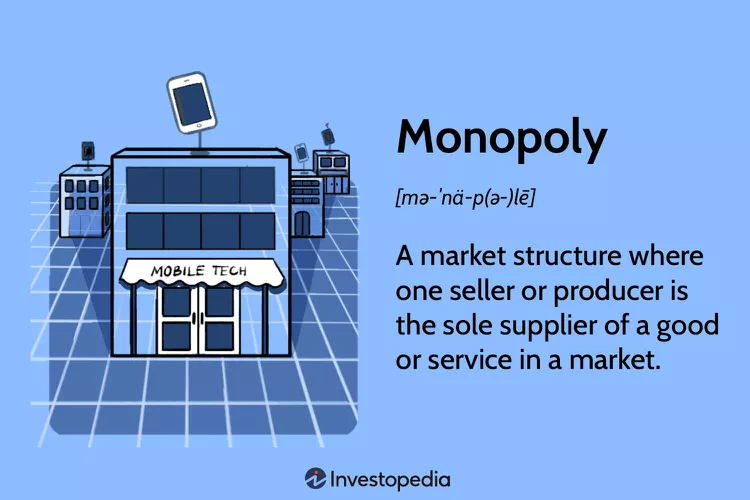
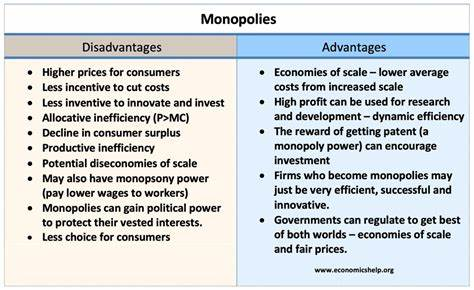
Investopedia provides a concise description of the definition of a monopoly as well as some of its Pros and Cons:


I hadn’t thought about the economic intricacies of monopolies until this fuss about the government suing companies as well as companies suing other companies over the issue of monopolies (for much, much more information,  search on the phrase “Companies accused of monopoly” and you should get this:


“About 1,690,000 results Companies accused of monopoly include: Amazon, Apple, Google, Facebook, and Microsoft”  ...followed by another list of articles which not only indicate the raised interest in this issue but should satisfy even a lawyer’s curiosity.


 I was certainly not aware of the actual Pros and Cons of a Monopoly and I only have fond memories of playing the Parker Brothers version of the game of Monopoly as a kid growing up in Atlantic City, NJ. In the unhappy circumstance you have never experienced the pleasures of  playing  Monopoly, I instructed the Bing AI to explain the rules of the game, receiving the following response,


“Monopoly is a classic board game designed for 2-8 players1. Here are the basic rules:

  1. Objective: The goal of the game is to bankrupt your opponents by buying property, building houses, and charging rent1.

  2. Starting the Game: Each player is given a fixed amount of play money at the start1. Players move around the board according to the throw of a pair of dice1.

  3. Buying Property: Any player who lands on an unowned property may buy it1. If a player can’t or doesn’t want to purchase it, it is auctioned off to other players2.

  4. Paying Rent: If a player lands on a property owned by another player, rent must be paid to that player1.

  5. Banker’s Role: One player is selected to be the banker, who hands out deeds, makes change, and distributes money to other players1.

  6. Winning the Game: The game ends when only one player remains. 

Remember, Monopoly can be a long game, especially with more players. Enjoy your game! 😊

Learn more: 1. Britannica.com  2. Bargames101.com 3. Wikihow.com”

(I’m not sure if I enjoyed or was annoyed by the smiley face}


In this version, only the Pros of unfettered Capitalism are rewarded, the goal being to drive the other players into bankruptcy, thus winning the game.


Until I did the research for this article, I did not know that the original game of Monopoly was created over one century ago,  not to extol but to expose the evils of capitalism. “In 1903, Georgist Lizzie Magie applied for a patent on a game called The Landlord's Game with the object of showing that rents enriched property owners and impoverished tenants. She knew that some people would find it hard to understand the logic behind the idea, and thought that should it be put into the concrete form of a game, it might be easier to demonstrate. She was granted the patent for the game in January 1904. “ (Wikipedia (which, by the way is now asking for well-deserved donations))


I also  discovered that while originally being banned in China as it conflicted with the values of communism, the game has been reinstated for manufacture in order for China to participate in the World Trade Organization. Never underestimate the power of greed


On a more personal note, the version of the Monopoly game that I learned to play was as a child living in Atlantic City, NJ where the streets and other common geographical features ( like the boardwalk) were named after places I already knew so like most children my age I just accepted that as another feature of my reality without giving it a thought  --- I was like  a fish unaware that I was underwater --- it just was what it was. 


 When our family moved to Washington D.C. and we were playing the game I experienced this weird feeling that the street names  weren't right, they were not the same as where I was now living.  This feeling was replaced by the staggering  insight that streets and their  names do not follow you as you move about the country. It was a simultaneous blow to my ego and a startlingly delightful insight that caused me to laugh out loud. I still smile when I think about it. The world, in fact, does not revolve around any of us, except of course, for certain politicians and other thespians who shall, for purposes of this column, remain unnamed.


Technology and Monopoly: An Intricate Dance


In a world where technology governs our daily lives, the rise of monopolies has become an unavoidable reality. Innovative products and services are often developed by tech giants, who wield vast control and power over the market. While these monopolies drive technological advancements and fuel economic growth, their dominance raises concerns about ethics, privacy, and competition.


The tech landscape is constantly evolving, with companies like Amazon, Google, and Facebook leading the way. These corporations possess the resources and influence to shape our digital experiences. They introduce groundbreaking technologies, such as artificial intelligence, virtual reality, and blockchain, that have the potential to revolutionize entire industries.


On one hand, these advancements contribute to the convenience and efficiency of our lives. From personalized recommendations and efficient online shopping to instant communication, the benefits are evident. However, the downside of such monopolistic control becomes apparent when competition is stifled, consumers face limited choices, and innovation is deterred.


Many argue that monopolies gain an unfair advantage through their immense data collection capabilities. With user data becoming the new gold, these tech giants have access to a treasure trove of information. They can analyze user preferences, behaviors, and habits, enabling them to deliver more tailored products and services. However, this also raises concerns about privacy and the potential for these companies to exploit personal data for their own gain.


The intersection of technology and monopoly gives rise to important questions about regulatory oversight. Governments and policymakers worldwide are grappling with the need to strike a balance between fostering innovation and safeguarding the interests of society. Antitrust laws and regulations attempt to prevent monopolies from engaging in anti-competitive practices, ensuring fair competition and protecting consumers.


Efforts to curb the power of monopolies have gained traction, with landmark cases and investigations targeting the likes of Google and Facebook. Calls for more transparency, data privacy regulations, and the promotion of healthy competition are becoming increasingly urgent. The aim is to preserve the benefits of technological innovation while avoiding the negative consequences of unchecked monopolistic dominance.


As the ever-expanding realm of technology continues to shape our lives and reshape industries, the relationship between technology and monopoly remains complex. It is a dance where innovation, convenience, and concern must find a harmonious coexistence. Striking the right balance is crucial in ensuring that technological progress benefits all, without sacrificing competition, privacy, and consumer choice.


Oct 2023 Curiouser and Seriouser

                   Curiouser and Seriouser


Perhaps you recognize this odd title which is a  modified and somewhat mangled version of a passage  from Lewis Carroll's fairy tale, Alice in Wonderland,  

(“Curiouser and curiouser!” cried Alice (she was so much surprised, that for the moment she quite forgot how to speak good English); “now I’m opening out like the largest telescope that ever was! Good-bye, feet!” (for when she looked down at her feet, they seemed to be almost out of sight, they were getting so far off) “Oh, my poor little feet, I wonder who will put on your shoes and stockings for you now, dears? I’m sure I shan’t be able! I shall be a great deal too far off to trouble myself about you: you must manage the best way you can;—but I must be kind to them,” thought Alice, “or perhaps they won’t walk the way I want to go! Let me see: I’ll give them a new pair of boots every Christmas.”)


However, this title  pretty much sums up my reactions to the latest gush of news stories relating to the new and improved AI-powered version of the World Wide Web (aka the Internet). 


A particularly enlightening viewpoint was presented in the 10/06/23  PBS NewsHour interview of Maria Ressa, the veteran journalist and past Nobel Peace Prize recipient where she discusses “The Future of AI”.  She is concerned about similar issues I have previously discussed  regarding the dangers in how the current AI- enhanced Internet is so devilishly effective in spreading Misinformation (benign misuse of Information) and Disinformation ( weaponized and targeted lies presented as fact).   


She begins by pointing out that if you can’t have integrity of facts, you can’t have integrity in elections. This seems obvious but she goes on to argue that research has shown that lies or disinformation spread six times faster than facts (remember the epigram attributed to Mark Twain, “A lie spreads half-way round the world while the truth is still getting its boots on”). 


This situation is destined to worsen,  not only because of the reach and speed of the Internet but our wired-in human weakness of confirmation bias --- our propensity to accept “facts” that confirm existing beliefs or values and discredit conflicting views. “People display this bias when they select information that supports their views, ignoring contrary information, or when they interpret ambiguous evidence as supporting their existing attitudes. The effect is strongest for desired outcomes, for emotionally charged issues, and for deeply entrenched beliefs. Confirmation bias is insuperable for most people, but they can manage it, for example, by education and training in critical thinking skills.” (Wikipedia)  Personally, I think this to be an insurmountable problem (unless you can become a fully enlightened being as prescribed by Buddhism) but that just might be my own confirmation bias. 


Recall that an AI is trained and learns from the readily available data on the Internet as well as learning from other AI programs much like we begin by learning basic knowledge and skills originally from our parents but as we grow and learn from our friends and family and  all of the other institutions provided by our society: schools, churches, libraries and yes, even from sources like this newspaper you are currently reading --- and if you are an active reader, you are learning and generating new ideas which you can in turn share with your friends and neighbors... and the beat goes on, This process can be replicated by an AI,  so it’s easy to see how fast it feeds and  grows until it becomes bloated with Information, Misinformation and Disinformation with which it can form its very own confirmation biases and who is to say which biases are bette r or worse -- the one it forms or the ones we create from our own experience?


 For example, consider the recent article in the Washington Post ( Cat Zakrzewski October 7, 2023 at 8:00 a.m. EDT)


Amazon’s Alexa has been claiming the 2020 election was stolen

The popular voice assistant says the 2020 race was stolen, even as parent company Amazon promotes the tool as a reliable election news source — foreshadowing a new information battleground.

Asked about fraud in the race — in which President Biden defeated former president Donald Trump with 306 electoral college votes — Alexa says it was “stolen by a massive amount of election fraud,” citing Rumble, a video streaming service favored by conservatives. Amid concerns the rise of artificial intelligence will supercharge the spread of misinformation comes a wild fabrication from a more prosaic source: Amazon’s Alexa, which declared that the 2020 presidential election was stolen.

Asked about fraud in the race — in which Joe Biden defeated President Donald Trump with 306 electoral college votes — the popular voice assistant said it was “stolen by a massive amount of election fraud,” citing Rumble, a video-streaming service favored by conservatives.


The 2020 races were “notorious for many incidents of irregularities and indications pointing to electoral fraud taking place in major metro centers,” according to Alexa, referencing Substack, a subscription newsletter service. Alexa contended that Trump won Pennsylvania, citing “an Alexa answers contributor.”


Multiple investigations into the 2020 election have revealed no evidence of fraud, and Trump faces federal criminal charges connected to his efforts to overturn the election. Yet Alexa disseminates misinformation about the race, even as parent company Amazon promotes the tool as a reliable election news source to more than 70 million estimated users.  Amazon declined to explain why its voice assistant draws 2020 election answers from unvetted sources.”


And as I write this,  I learn that fake images of the ongoing war in Palestine have been appearing on social websites such as Facebook spreading false information by one side or the other. Whether this is wartime propaganda or the desire to be “liked” is irrelevant. It is just plain wrong and technology is providing us with the means to do it. However difficult, it is incumbent upon ourselves to place some guardrails on this process.


Wednesday, September 6, 2023

 If you’re a Staunch Capitalist, Don’t Read This 


And here’s why --- I’m rapidly approaching the age of 85  and it’s my sneaky way of satisfying my last wish and final request while I’m still alive and kicking (well, at least limping along). Although I invite comments to these pieces, I rarely receive them except  from folks my wife or I happen to know or perchance bump into while shopping. 


As far back as I can remember, I have wanted to teach and even recall  being brainwashed by my mom calling me her “little professor”.  I eventually partially fulfilled her prophecy by becoming a Professor (of Computer Science at SUNY Plattsburgh).  I have no idea  whether my basic motives for teaching or writing this column are driven by lust for fame or the fact that acquiring knowledge and then getting to share it with others is fulfilling and that just makes me happy.


The other reason I write is that I believe that writing clarifies thinking and it should be the main reason that it be taught to everyone as soon as possible. Just the act of “sitting right down and writing myself a letter” forces me to better organize my thoughts and hence my understanding of things I’m curious about --- like the complex interactions between technology and society and the issues that arise such as Privacy, Security, and Freedom of Expression. Usually, solutions to these problems inevitably give rise to new issues to consider like Artificial Intelligence and how to apply it usefully and justly. I know I’ve said something like this before, but what seems to separate us humans from other animal life is our propensity for creating problems for ourselves and, in attempting to solve them,  creating newer and more interesting problems to solve. 


If you got this far I’m assuming you are interested in what I have to say (whether or not you agree or disagree or chose to comment) and perhaps know of others who also might be interested. With all that as prelude, here’s the pitch:  As I write this column gratis and there is no personal  financial reward, and you’re are willing to believe that it is not just another case of ego  stroking for yet another psychopathic personality common to many politicians and other thespians, I would appreciate your advice on how best to get this column out to other sources, particularly small town newspapers. I still believe that a newspaper (print or internet) is the best way to deliver news that is edited responsibly.


Send any suggestions you may have to denenbsa@gmail.com and you have my word. they will be immensely appreciated.


Now let’s get down to business with the presentation of this month’s article which is entitled,


A stream of consciousness look at my process of creating this article


A recent PR editorial railing about how the first amendment was violated by a seemingly mean-spirited, overzealous  police search and seizure raid of  a small local newspaper in Kansas immediately aroused my curiosity about this situation. I felt it was one-sided as it only contained irate statements from other news organizations and none from the police as to why the raid was hatched in the first place.  I was not the only one who suspected a juicy soap-opera as the Internet exploded and so it took quite some time to sort out exactly what happened when and why the situation occurred in the first place.


The Internet tends to have too much information and the situation turned out to be much, much more complicated thanI had anticipated. Each new article I read added more information and layers of complexity, so I did what any normal reader would do: I gave up. But it was important enough to put it on the back burner figuring all would be revealed in the following weeks. I was temporarily satisfied to categorize it as just another  dispute arising from the natural tension between the Politicians and Police (who, not unsurprisingly, are appointed by the politicians ) vs the Press and let it simmer till done. Serendipitously, one of my favorite sources, The Washington Post, came out in its 8/26 Evening Edition with a comprehensive, convincing and interesting article explaining the whole megillah. Decide for yourself by searching on, “How A small-town feud in Kansas sent a shock through American journalism”  If you do, be sure to read the ironic first comment which pointed out that the raid could have been avoided if the judge who approved it had followed the law and issued a summons instead of a search warrant.


While I was in  the process of surfing the Net for more details on the Police raid, I stumbled upon the site, ProCon.org,  which primarily serves an audience of educators to help them understand and teach about various societal issues by presenting their Pros and Cons from a variety of sources. I quickly realized that many, if not most ,of my columns are also centered on the pros and cons of various issues that arise due to the symbiotic as well as the disjointed and unhelpful relationships that arise between Technology and Society.


I  believe that the largest Pro or best outcome could very well be that the Internet, when properly utilized, can help us fulfill a measure  of what  a successful society should be aiming for as formulated by the mathematician and philosopher Alfred North Whitehead, “Civilization advances by extending the number of important operations which we can perform without thinking about them.” 


While one may not entirely agree with this formulation as it appears to deprecate thinking itself, paradoxically it does not as he also has said “The purpose of thinking is to let the ideas die instead of us dying.” If that sounds confusing to you, welcome to the club but I found the consensus of opinions as to its meaning is something like: when thinking about a problem usually many ideas come to mind and it’s very easy to just acquiesce and choose  the most pleasing one for the moment. Whitehead would view this to be a form of mental laziness and probably would not yield the best result. It would be a  more effective strategy to carefully examine all of the conflicting  ideas before choosing one and let the others die.  In any case, before this article drifts too far into the realm of esoteric philosophy, let’s examine the cons or negative consequences of an Internet Technology that has been  supercharged with Artificial Intelligence .


It seems the pros and cons are in a race to dominate AI but I believe that the most worrisome aspect of  the Internet is in its indiscriminate intermixing of information, misinformation and disinformation which not only contributes to confirmation bias but most importantly, to the disintegration of the basic glue which holds society together --- trust  --- or at least a minimal level of civility when discussing contentious issues.  In my younger days, working as a programmer, I had  a boss who lived through World War II and he observed that, although those times were tough for everyone, still it was a good time to be alive because it united the country ; we were all working together on a common goal --- to defeat the Axis powers,  so there was no time for meanness and petty political bickering. 


I hate to think that it will take a disaster to get us back to a wholesome, working society especially if it manifests as a civil war or as the results of climate change, but I would not be surprised if that’s the future we are foreshadowing for our children and grandchildren.


Search This Blog